
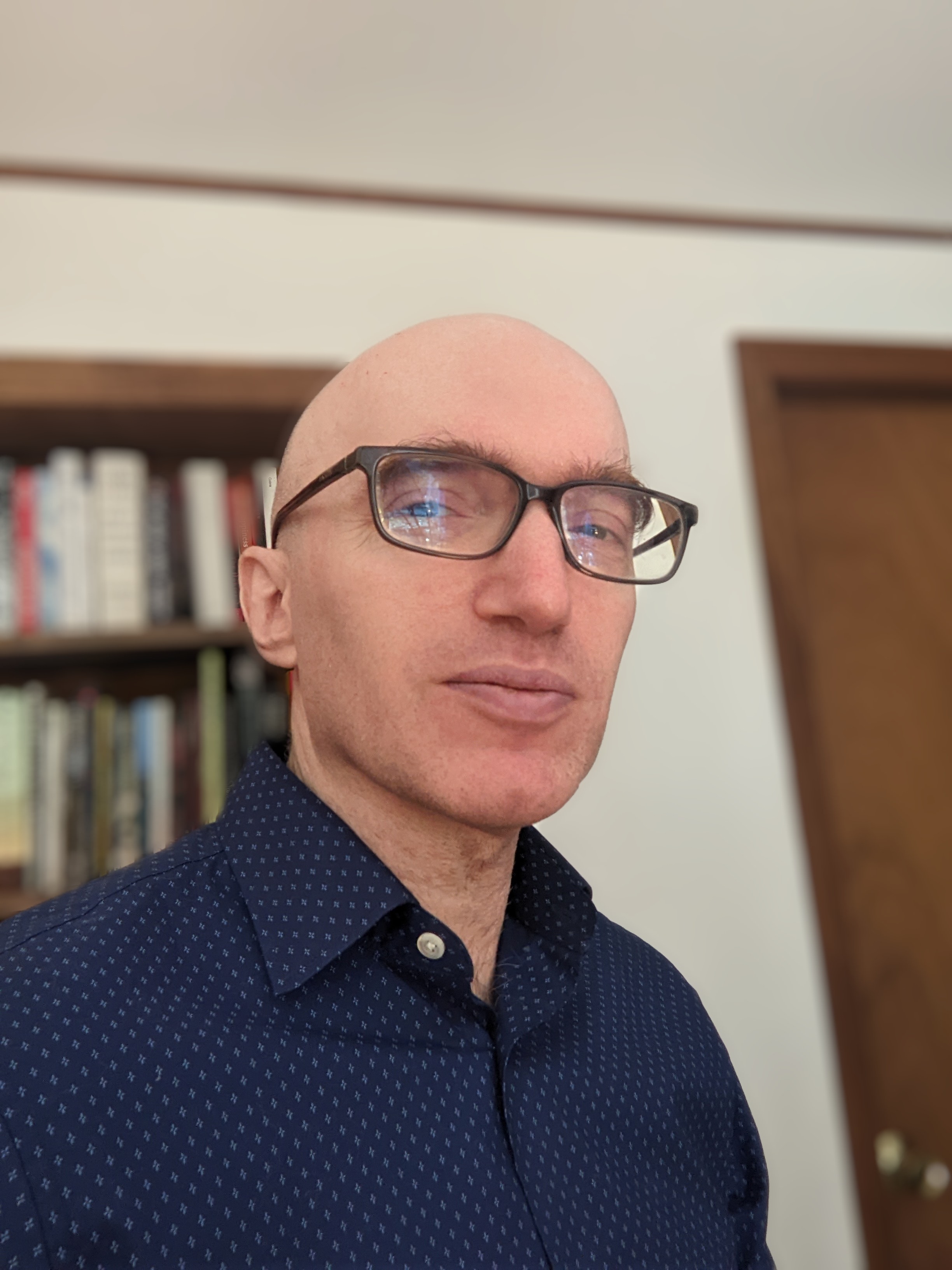
Daniel Gallant (ARAD ’04) has reached an exciting new career milestone as the Executive Director at House of SpeakEasy. We are incredibly proud of his accomplishments and thrilled to reconnect with him to learn more about his journey. Read the full interview below!
Background and Influences:
Could you share what background and experiences have shaped your career path, particularly your journey into arts administration?
I started out as a playwright and director, founded a theater company in college, and then tried to pursue a career in dramaturgy (because I loved that profession’s crossdisciplinary focus on theater, writing and research). I had a great time conducting dramaturgical research at the Library of Congress for productions at the Studio Theatre in Washington, D.C., and I received a shout-out in a New York Times review of Waiting for Godot, but it soon became clear that dramaturgy was not a viable path for full-time work.
I was offered a job at a talent agency in NYC, as assistant to the vice presidents of two performing arts departments, so I picked up and moved to Manhattan, where I lived in a tiny room, saw lots of shows and concerts, and dreamt up adventurous theater plans (though I didn’t yet have the skills or connections to act on them). At the talent agency, I learned a lot about contracts, negotiations and outsize personalities, but my passion was for the collaborative artistic process – and in particular, developing and presenting new works by promising writers. I left the talent agency, started another theater company, and supported myself by working for dot-coms during the day (this was in the midst of a tech boom – a time when almost anyone with a business plan for a website could rustle up hundreds of thousands in speculative funding). I worked for over a dozen startups, and wrote plays, ad copy and grant proposals for my theater company at night.
One day, I wandered into a venue called Makor, on the Upper West Side. It was a cultural center that was just getting started, and although the event spaces in their five-story building seemed ideal for dramatic presentations, they didn’t have a consistent theater program. I pitched the idea of a short play and monologue festival, featuring new works by a combination of rising and established playwrights. The management gave a thumbs-up, as long as I didn’t need a budget! The good news: I had become very accustomed to producing shows on a shoestring. I learned – through trial and error – how to turn a theater festival with zero funding but lots of talented, energized artists into a popular series. I also started using digital marketing tools to promote our events online, at a time when most arts entities hadn’t yet adopted those resources. Our festivals attracted audiences and press, and I was offered a job when Makor became part of a much larger arts and cultural entity, the 92nd Street Y.

Post-Graduation Journey:
What steps did you take after graduating from the ARAD program that led you to your current role at the SpeakEasy Foundation?
While in the ARAD program, I interned at the Public Theater (where, as luck would have it, House of SpeakEasy now presents its flagship monthly event series). While at ARAD, I continued writing, directing, and producing short theater works around the city. After graduation, I returned to Makor and the 92nd Street Y in an augmented role, as director of a burgeoning theater program. I stayed in that position for four years, still producing some shows and concerts on the side, and consulted with a Broadway producer. I also helped to design and program the Tribeca Arts Center that the 92nd Street Y opened in the late 2000s. Then, an Executive Director position became available at the Nuyorican Poets Cafe – a legendary downtown venue, dramatically different from the uptown, more homogenous, and traditional vibe of the 92nd Street Y, although both venues worked in the same mix of art forms. A love of spoken word performance, and of experimental, edgy, resonant, and relevant new writing drew me from the more institutional setting of the Y to the grassroots, vibrant, and passionate arts scene of the Lower East Side. After many fulfilling years at the Cafe, and having consulted for a variety of performing visual and literary arts organizations, I joined House of SpeakEasy – a wonderful foundation that offers literary performances, readings, lectures and workshops; presents school visits by renowned authors; and distributes free books in neighborhoods that lack bookstores and libraries.
ARAD Contributions:
Were there any specific courses, projects, or experiences during your time in the ARAD program that you found especially helpful in building the skills needed for your career?
The multidisciplinary nature of the ARAD program was tremendously useful. Even though I had started out working in the performing arts field soon after college, there were a number of knowledge and skill areas vital to arts management that I would have had no way to pick up in an office setting. You don’t know what you don’t know, and prior to ARAD, I had very little working knowledge of nonprofit law, intellectual property law, board dynamics, how annual audits worked, etc. It’s difficult to learn about those areas while you’re on the job, but ARAD offered a solid grounding in each of them.
I also really benefited from practical instruction in statistical analysis and probability theory. The statistics that most of us study in high school or college tend to be hypothetical, but in grad school, I was finally able to see the application of those skills to budgeting, forecasting, marketing, and generating financial reports for arts programs. A lot of the skills that seem dull in the abstract become useful and fascinating when you learn to apply them in an area of personal and practical interest – like raising money to produce a poetry festival.
Career Aspirations:
What are your long-term career aspirations, and how do you see your current role at the SpeakEasy Foundation contributing to achieving those goals?
I’m fortunate to already be working in a career that fulfills a lot of my goals. At both the Cafe and SpeakEasy, I’ve been able to work with writers, performers, educators, literary professionals, community leaders, funders, and government officials who are focused – as I am – on bringing inventive, transformative works of literature and theater to a wider audience, and training students to write and perform their own deeply felt stories.
Advice for Current Students:
What advice would you offer to current ARAD students as they prepare for their careers in arts administration or related fields?
Use your time in grad school to intern and volunteer at as many arts organizations as you can (without driving yourself crazy). Get to know what management practices work and don’t work well in the sort of organizations where you would like to see yourself. Request informational interviews with arts leaders from the genre or medium you aspire to work in. It’s often easier to make those connections as a student than after graduation. Ask professors and alumni from the ARAD program for advice and connections. And don’t be afraid to try a job, project or internship that’s somewhat outside your field of specialization – you never know what useful insights and skills you’ll pick up by trying an unfamiliar professional activity.
The most importantly – experience lots of art! Remember why we’re all in this field – because artistic creativity leads to enlightenment, transformation, education, and empathy. Take advantage of the many unique arts encounters that NYC offers. The most effective arts leaders are those who remain consistently inspired by the creativity around them.

About Daniel Gallant
Daniel Gallant is a development and communications strategist for arts and cultural entities, as well as a writer, lecturer and event producer. NPR’s Planet Money called him “a genius at raising money for artists.” Daniel is a board member of the Nuyorican Poets Cafe, where he served as Executive Director for 13 years and raised tens of millions of dollars to fund programs, operations and a significant capital renovation. According to the Wall Street Journal, Daniel grew the Cafe “from a small, volunteer-led venue best known for weekly poetry events to a thriving arts center.”
Daniel has lectured and consulted about marketing, fundraising and communications for organizations including the Kennedy Center, PEN America, Brooklyn Academy of Music, Chase, Banff Arts Centre, the Japan-US Friendship Commission, Google, the 92nd Street Y, Bloomberg Philanthropies, the Lower Manhattan Cultural Council, Opera America, Fourth Arts Block, The Field, Foursquare, Columbia University, Harlem Writers Guild, Griffith University, and many more.
His writing has also appeared in Time Out New York, the Huffington Post and in seven anthologies from Vintage Books, Applause Books and TCG; and he has appeared on MTV, PBS, NBC, ABC, FOX, NY1 and other networks. He has lectured and consulted for universities and cultural organizations in Canada, Spain, Japan, Portugal and Australia. And he has served on grant and fellowship panels for organizations including the NYC Department of Cultural Affairs, the Lower Manhattan Cultural Council, the Field and the Bronx Council on the Arts.
 Arts Administration
Leave a comment