
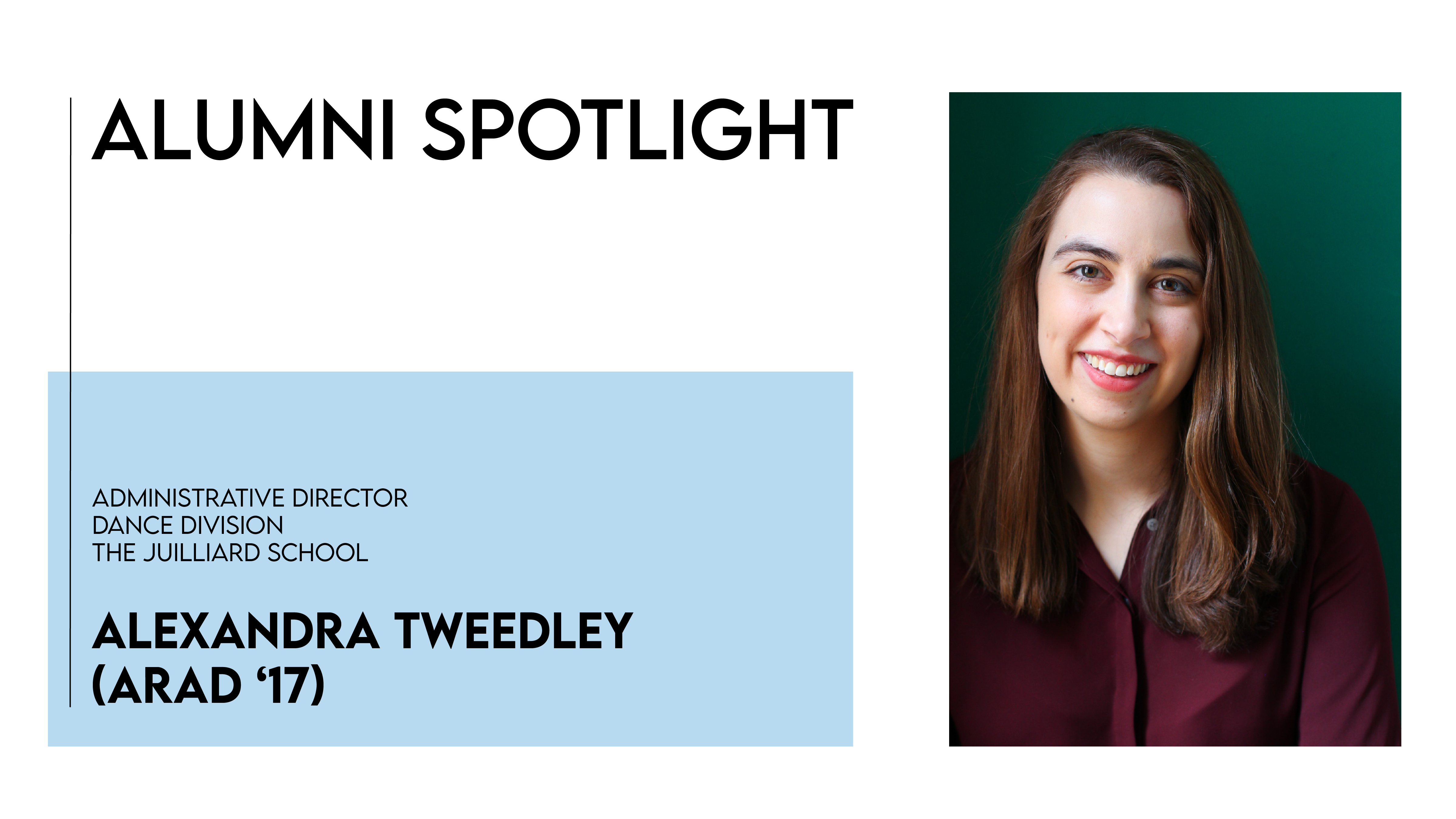
We are thrilled to share the spotlight on Alexandra Tweedley ( ARAD ’17) and celebrate her recent promotion to Administrative Director of the Dance Division at The Juilliard School. In our latest interview, Alexandra shares insights into her visionary leadership and the exciting new projects on the horizon for Juilliard’s Dance Division. Let’s check out how much she has accomplished since graduating in 2017, and we’re excited to catch up with her again after our interview in 2022.
As you step into your role as Administrative Director, could you tell us about any new projects or initiatives you’re excited to bring to the Dance Division?
My role in the Dance Division as Administrative Director is to help realize the vision that our Dean & Director, Alicia Graf Mack has for division. I look forward to being a resource to her in this capacity.
What immediate goals have you set for the Dance Division, and how do they align with Juilliard’s mission?
Under the leadership of Dean & Director Alicia Graf Mack, we aim to incorporate the values of Juilliard into everything that we do in the Dance Division. Those pillars are Equity, Diversity, Inclusion, and Belonging, Creative Enterprise, and Artistic Excellence.
How has your experience evolved from starting as an assistant to becoming the director? How has your work changed during this journey?
I’ve worked in the Juilliard Dance Division since summer 2017, right after I graduated from ARAD. Every year at Juilliard has been different, learning new things and taking on new challenges. I started as the Administrative Assistant, then Administrative Associate, Events and Projects Coordinator, Assistant Director and now Administrative Director. We’ve had lot of change in my time here, particularly with the challenges of the pandemic, but it has been wonderful working with an amazing staff and faculty and of course our incredible students.
In your opinion, what are the key qualities for a leader in arts administration?
Working as an Arts Administrator as well as in a higher education environment, I am lucky to see the artists of tomorrow and learn what they need to succeed in their craft. I think all leaders in arts administration should be looking to emerging artists to better understand how to shape the field of tomorrow.

You’ve always been great at working with different departments and organizations. How do you plan to enhance these collaborations to benefit the Dance Division and its students?
Creative Enterprise is one of the pillars of Juilliard’s mission and a huge part of what we do. We are constantly looking for opportunities for our students to collaborate across divisions to enhance their education. This mission also extends to our faculty and staff, supporting these projects and working collaboratively to make them possible. We hope to continue these collaborations and seek new opportunities for our dancers to grow their artistry.
With the increasing importance of technology in the arts, how do you envision digital innovation influencing dance education and performance at The Juilliard School?
Digital innovation already has had such an impact on our division, first out of necessity during the pandemic and has grown since then. We quickly had to pivot to virtual offerings during the pandemic, increasing our technological capabilities first to make classes possible and then with livestream capabilities in our performance spaces to reach our audiences.
We also have increased the curricular offerings for dancers related to technology, including a course on dance composition using film as a medium and our students often explore incorporating technological elements into their independent projects.
Finally, reflecting on your career and the evolving landscape of arts administration, what updated advice would you give to students aspiring to leadership roles in top arts institutions?
My advice would be to listen – listen to the artists, the administrators, the artistic staff, and all who make the institution run. I have found working with staff, faculty, and students is best to move forward with the knowledge of their experiences to make informed decisions and advocate for our community. If you aren’t yet in an institution where you can do a listening tour, then reach out to those who are for information interviews. Their experiences are so informative for where the field is today. You never know where that conversation may lead!
 Arts Administration
Leave a comment